Summary
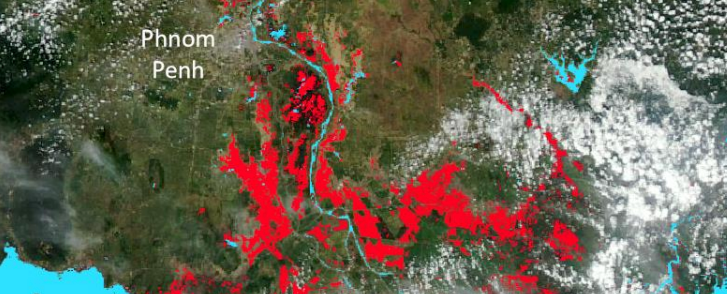
The MODIS Near Real-Time Global Flood Product (Collection 61) (Release 1) (MCDWD) is processed by NASA's Land, Atmosphere Near real-time Capability for EO (LANCE). Release 1 succeeds the MCDWD beta releases available since March 2021. The LANCE MCDWD product itself replaces the previous NASA NRT Global Flood Mapping Product, which was available from 2011 through 2022. Note all flood products have been released under MODIS Collection 6.1 (the current version of MODIS data processing).
The Flood Product is a daily, near-global, ~250 m resolution product showing flood and surface water detected from the twice-daily overpass of the MODIS optical sensors (onboard Terra and Aqua satellites). To minimize false-positives from cloud and terrain shadows, we employ a multi-observation compositing approach, and generate the product over three compositing periods (1-day, 2-day, and 3-day). The most optimal composite for a given flood event will depend on: the specific area of interest; cloud cover over dates of interest; potential spatial extent of likely flood water; and likely duration of flooding. Because the 1-day composite can often be contaminated with excess cloud-shadow false-positives, the 2 and 3-day composites are generally preferred, unless latency is critically important, and/or clouds are not a concern on the given date. Currently, only the 2- and 3-day composites are viewable in Worldview, but all are available in the downloadable product files.
Product generation consists of three key steps:
-
Water detection algorithm applied to MODIS observations (Terra and Aqua)
-
Compositing of water detections over 1, 2, and 3 days, to minimize false positives and fill in observations as clouds move.
-
Differentiating flood from expected surface water (using a reference water mask).
For more information please see the MODIS NRT Global Flood Product User Guide.
Updates
April 16, 2024: Release 1 version published (User Guide Revision D). The major components of this update include: adjusting the compositing threshold to minimize false-positives at higher latitudes; updating the reference water layer to address issues with new water bodies (mostly reservoirs filled after 2003); and expanding production to additional tiles. Note also the layer names in the HDF product file have changed, which may impact any automated processing routines.
January 12, 2023: Release of Beta 2 version, with User Guide Revision C. This update adds use of a general topographic filter to remove water detections from mountainous areas, greatly reducing the number of terrain shadow false-positives in such areas.
March 5, 2021: Initial beta release (User Guide Revision A)
Product Details
Short Name: MCDWD_L3_NRT
Long Name: MODIS/Aqua+Terra Flood Map Daily L3 Global 250m LLL Grid NRT
Platform: Aqua and Terra, Instrument: MODIS
DOI (Main HDF product):10.5067/MODIS/MCDWD_L3_NRT.061
DOI (GeoTIFFs of each composite):
1-day: 10.5067/MODIS/MCDWD_L3_F1_NRT.061
1-day with cloud-shadow screening: 10.5067/MODIS/MCDWD_L3_F1C_NRT.061
2-day: 10.5067/MODIS/MCDWD_L3_F2_NRT.061
3-day: 10.5067/MODIS/MCDWD_L3_F3_NRT.061
User Guide: MODIS NRT Global Flood User Guide: revision D (Release 1), April 2024
Support:
- Contact Earthdata Support
- To be notified of updates, please email floodmap-join@lists.nasa.gov (no text or subject required)
- To unsubscribe:e-mail floodmap-leave@lists.nasa.gov (no subject or text is required)
- Main POC - Dan Slayback, NASA Goddard Space Flight Center
Data Access / Download
View the data in Worldview: https://go.nasa.gov/3OiKtYB and view the "Assessing Floodwaters" Tour Story in Worldview: https://go.nasa.gov/3kglhIJ
HDF and GeoTIFF Product Downloads:
- Earthdata LANCE-MODIS page
- LANCE servers: https://nrt3.modaps.eosdis.nasa.gov (primary), or https://nrt4.modaps.eosdis.nasa.gov (backup/secondary)
For HDF files navigate to NRT Data → allData → 61 → MCDWD_L3_NRT
or, go directly to
https://nrt3.modaps.eosdis.nasa.gov/archive/allData/61/MCDWD_L3_NRT
For GeoTIFFs (one for each of the 4 flood composite products in each HDF file)
navigate to NRT Data → allData → 61 → MCDWD_L3_F<X>_NRT (where X is the composite of interest: 1, 1C, 2, or 3).
Or, go directly to:
https://nrt3.modaps.eosdis.nasa.gov/archive/allData/61/MCDWD_L3_F1C_NRT
https://nrt3.modaps.eosdis.nasa.gov/archive/allData/61/MCDWD_L3_F1_NRT
https://nrt3.modaps.eosdis.nasa.gov/archive/allData/61/MCDWD_L3_F2_NRT
https://nrt3.modaps.eosdis.nasa.gov/archive/allData/61/MCDWD_L3_F3_NRT
Downloading products requires free registration with the Earthdata Login registration system.
For automated and bulk download see the following instructions: https://nrt3.modaps.eosdis.nasa.gov/help/downloads
Users automating downloads by repeatedly polling the servers for new files would be advised to retain the file modification times for downloaded files and compare these to times observed on subsequent polls to determine if a file has been updated and thus should be re-downloaded.
Please see the FAQ, What is the best way to obtain the flood product?
Tile Map
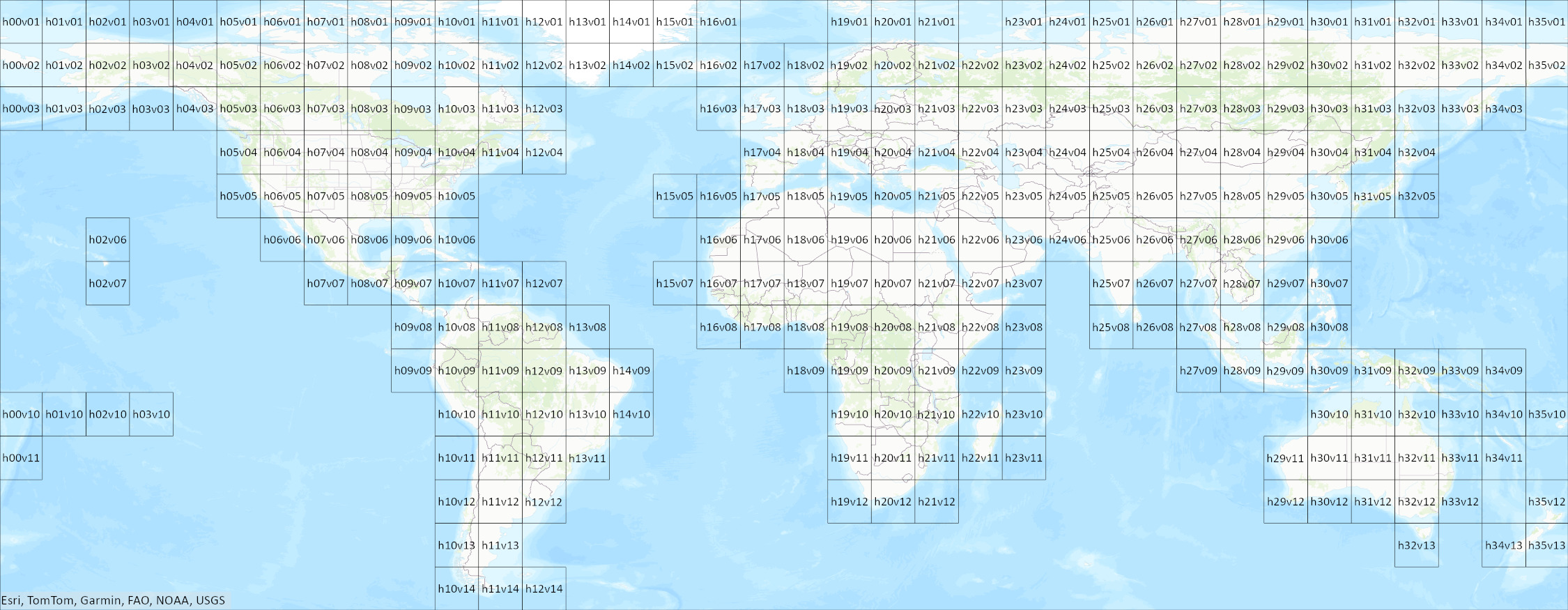
Click on image to view larger version.
Citation and Disclaimer
Please use the following citation: NRT MODIS/Aqua+Terra Global Flood Product MCDWD_L3_NRT distributed from NASA LANCE. Available on-line [https://www.earthdata.nasa.gov/global-flood-product]. DOI: 10.5067/MODIS/MCDWD_L3_NRT.061
For Disclaimer, please see the LANCE Disclaimer.
Legacy NASA NRT Global Flood Mapping Product
From 2012 through 2022, the precursor legacy NASA NRT Global Flood Mapping Product was being generated. Although very similar, the product had slightly different characteristics (tile naming; pixel size) and output products (including a graphic product and a 14-day product). The legacy product used a “MWP” filename prefix, such as “MWP_2022123_080E030N_3D3OT.tif.” Users transitioning from using the legacy product to the new LANCE MCDWD product should in particular review section 7 of the User Guide for relevant differences.
Frequently Asked Questions
Which product will show me the water for a particular flood event?
It is recommended users read section 8.1 (Usage Notes) of the User Guide to better understand the caveats of using the global flood product. Buildings, canopy cover, cloud, and cloud-shadow can obscure flood detection and terrain shadow, cloud-shadow, and volcanic rock can lead to false-positive flood detections. It can also be helpful to examine the corresponding MODIS reflectance imagery in NASA Worldview (https://worldview.earthdata.nasa.gov) to determine the level of cloudiness on the dates of interest, and thus potential sources of false-positives (cloud or terrain shadow) or false-negatives (cloud obscuration, or other data gaps).
Why can I only see the 2- and 3-day products in Worldview?
The 1-day product has more false positive flood detections, so to avoid misinterpretation, only the 2- and 3-day products are currently available in Worldview. The 1-day is available in the full HDF product file, or as separate geotiff files.
What caveats should be considered when using the flood mapping product?
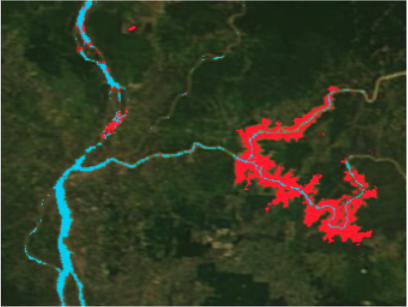
Incorrect reference water may result in flood false positives. Figure 1 shows a reservoir in Cambodia formed after the completion of the Lower Sesan II dam in 2017. Prior to Release 1, this reservoir was routinely reported as flood. With the updated reference water layer (see User Guide section 3.5) this is no longer occurring (the reservoir is now reported as “surface water”), but similar situations will occur with other newly constructed reservoirs, until they have been filled for ~3 years. Note that even then, if the reservoir levels vary seasonally or yearly, some edge areas may be reported as flood if the new reference water layer has not captured its maximal extent.
Volcanic lava fields will often trigger the water detection algorithm because like water, they are optically very dark. The user guide shows an example from the Craters of the Moon area of south-central Idaho.
Cloud and terrain shadow can lead to false positives. Please see section 8 of the User Guide for more information and examples.
Why was a particular flood not detected?
The usual culprit is clouds: If an area is simply too cloudy for the MODIS sensors to observe the surface during a flooding event at its overpass times of~10:30 a.m. (Terra) and 1:30 p.m. (Aqua) (mean local time), the flood will not be reported in this product.
Additionally, if the flood is small in extent (MODIS pixels are approximately 250 m), or if it is under canopy cover (trees will obscure underlying water), or in urban areas (streets may be flooded, but there is likely a larger proportion of non-flooded rooftops), it may not be captured.
As the product is based on observations at ~10:30 a.m. and ~1:30 p.m. local time, only water present at those times will be detected. This rules out the detection of most flash flood events (which are also often constrained to narrow valleys that may not be well-resolved at 250 m resolution).
Can I get a GeoTIFF of the flood product?
Yes, the four individual flood composites in the product HDF file are available as individual GeoTIFF files; please see links in the Data Download section of this guide.
What is the best way to obtain the flood product?
It is recommended that users view the 2- and 3-day flood products in Worldview as this allows rapid browsing of relevant dates, and the user can also view the relevant corrected reflectance imagery, making clouds and any anomalies in the imagery easier to evaluate.
See Data Download for more information on obtaining product files.
What is the difference between the 1-, 2-, and 3-day product?
The table below highlights the key differences between the various 1-, 2-, and 3-day composite products. Visual examples can be found in the user guide.
| Name | Description (per pixel) |
|---|---|
| Flood 1-Day 250m | Flood product, 1-Day: from current day’s data. (no cloud-shadow masks applied to water detections) |
| Flood 1-Day CS 250m | Flood product, 1-Day: from current day’s data. (cloud-shadow masks applied to water detections) |
| Flood 2-Day 250m | Flood product, 2-Day: from current and previous day’s data. |
| Flood 3-Day 250m | Flood product, 3-Day: from current and previous two day’s data. |
Why are there two 1-day products? Which should I use?
The 1-day CS product has cloud shadow masks applied to the water detections to help remove cloud-shadow false positives. However, these masks can be inaccurate, and thus may potentially remove real water, or they may not remove all cloud shadow. In general, it is recommended that the 1-day product is used only if either: the most timely information is needed, or there are no potential cloud concerns. If there are clouds and the most timely information is required, then both 1-day products should be evaluated along with the visible imagery (most easily done via Worldview) to determine which provides the most useful information.
Why does a known reservoir show up as flooded?
The reference water layer tells us where “normal” water is expected to be observed: rivers, lakes, reservoirs, oceans. The current reference water layer is the initial version of the MOD44W product, c2009, and is increasingly out of date (see section 9.1 of the User Guide), leading to errors in the product. To address this, a new reference water layer is planned.
What are the differences between the new LANCE flood product and the legacy flood product?
The LANCE MCDWD 1-, 2-, and 3-day composite products are considered comparable with the legacy product, although the MCDWD has some additional features. Most notably, as of Release 1, the reference water layer has been updated, which greatly reduces the number of falsely reported floods from new reservoirs. The MCDWD also has an additional topographic mask (HAND) applied, which greatly reduces terrain shadow false-positives in mountainous areas (see User Guide section 3.4.2)
The distribution format is also different. The MCDWD LANCE product is delivered in one HDF file per tile, per day (with separate GeoTIFF files also available for the flood layers), whereas the legacy MWP product is delivered in one GeoTIFF file per day per composite period. Tile size (and pixel sizes) are also slightly different, and data values have changed. The table below shows the change in data values between the legacy MWP and LANCE MCDWD products. See User Guide section 7 for more information.
|
Description |
Legacy flood product (MWP) data values |
LANCE flood product (MCDWD) data values |
|---|---|---|
|
No Water |
1 |
0 |
|
Surface Water |
2 |
1 |
|
Recurring Flood* |
NA |
2 |
|
Flood |
3 |
3 |
|
Insufficient Data |
0 |
255 |
* Note the legacy product did not have the “recurring flood” label, and although this is planned for the LANCE product, it will not be implemented immediately
What improvements are planned?
Future improvements include: adding a new "recurring flood" output class to the product (to discriminate between regularly occurring flooding and unusual flooding), and incorporating VIIRS imagery to the product. See User Guide section 9 for more information.